
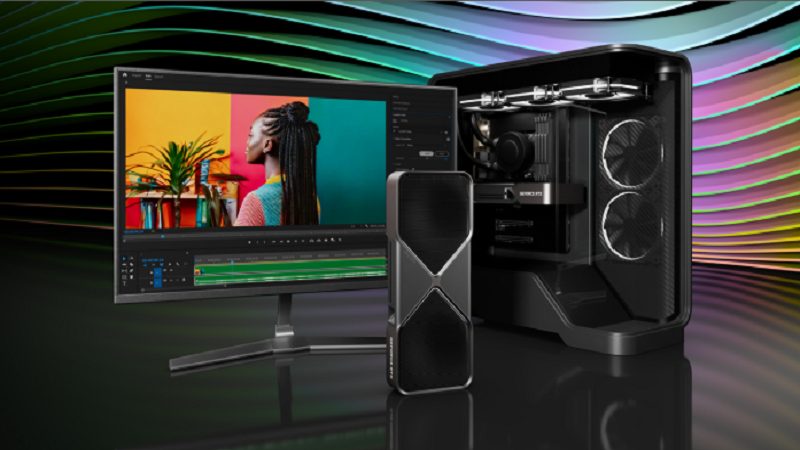
The pace of change within the creative sector is accelerating rapidly due to new capabilities involving visual creation via artificial intelligence, editing automation, and real-time rendering in daily workflow processes. It is necessary that creative professionals, from digital art studios to media firms, have equipment that can handle huge data sets without interfering with the deadlines of productions.
Traditional systems struggle with executing tasks such as generating imagery with artificial intelligence (AI), 8K editing, or deep learning at once. GPU-driven technologies solve this issue through improved speed and stability in their performance.
Why GPUs Have Become Essential for AI Creativity
Current AI software makes extensive use of parallel computing. While standard CPUs complete jobs sequentially, GPUs perform thousands of operations concurrently, enabling AI software to render images and animations on-the-fly.
An optimal configuration like the stable diffusion multi-GPU system assists artists in managing their AI workflow without being delayed by lengthy processing times. The utilization of multiple GPUs also enhances the efficiency of batch processing for studios dealing with high volumes of work.
The use of GPU-based processing has been instrumental for current AI art applications and AI animation systems. It allows artists to spend less time waiting for results and more time creating.
Real-Time Rendering Is Changing Production Speed
AI-powered content creation depends on rapid iteration. Artists often generate multiple outputs before selecting the final result. GPU-powered systems reduce render times dramatically, allowing teams to test ideas faster.
Real-time rendering also improves production flexibility. Effects can be applied, upscaling performed, and scene previews done without interruption in the workflow. This enables a more seamless environment for exploration and creativity.
Film studios that deal with huge media files require dedicated GPU memory for their work. These features help maintain stable performance even during demanding rendering sessions involving complex visual layers.
AI Video and Image Processing Require More Hardware Power
Today’s content creation pipelines incorporate AI upscaling, automatic masking, motion tracking, and video editing. Such processes require significant computational resources, particularly from graphics cards.
These types of systems can deal with such tasks in an effective way since they are built specifically to solve parallel computing problems. Artificial intelligence applications make millions of visual computations simultaneously, so high-end GPUs are no longer a luxury but rather a requirement.
Moreover, the growing usage of generation media solutions made it necessary to switch to systems with more VRAM.
Local AI Workflows Are Becoming More Popular
Locally running AI software offers better file control and privacy and eliminates any subscription constraints on a repeat basis.
Using an effective platform like the Stable Diffusion Standard Edition PC ensures that the image creation and other multimedia assets can be created without any issues.
Local workflows also improve productivity for studios working under strict deadlines. Without depending on internet-based rendering queues, teams can maintain faster turnaround times and uninterrupted creative sessions.
GPU Systems Support Multiple Creative Industries
AI-powered hardware is no longer limited to digital artists alone. These GPU systems are used by video production teams, game developers, architects, and marketers for their daily tasks.
For instance, GPUs assist in rendering scenes, special effects, and movie previews in filmmaking. By making this process quicker, the production team can easily modify the product in any way without having to wait for long.
Similarly, GPU-based systems help marketers in generating images and videos through artificial intelligence.
Hardware Stability Matters for Professional Workloads
Performance alone is not enough for professional environments. Stability and reliability are equally important when handling long rendering sessions or continuous AI generation workloads.
Enterprise-grade GPUs and optimized cooling systems help prevent overheating and sudden slowdowns. Stable systems reduce the risk of crashes that can interrupt production schedules or damage project files.
Fast NVMe storage and high-capacity RAM also improve workflow consistency. These components allow creators to manage large projects smoothly while reducing loading times during editing and rendering tasks.
The Future of AI Creativity Depends on Hardware Innovation
AI tools continue evolving rapidly, and hardware requirements are increasing alongside them. More advanced models require stronger GPUs, larger memory capacities, and faster system architectures to maintain efficient workflows.
Companies like Puget Systems and BOXX Technologies offer strong workstation solutions for creative industries, especially for rendering and AI-driven production environments. However, many professionals now look for systems designed specifically around real-world creative workflows instead of generic hardware configurations.
Cloud Ninjas stands out by focusing on optimized workstation solutions tailored for demanding production tasks, AI generation, and media-heavy workflows. The balance between performance, scalability, and workflow-focused configurations makes these systems highly practical for modern creators handling intensive creative software daily. Then stay in contact with our website